
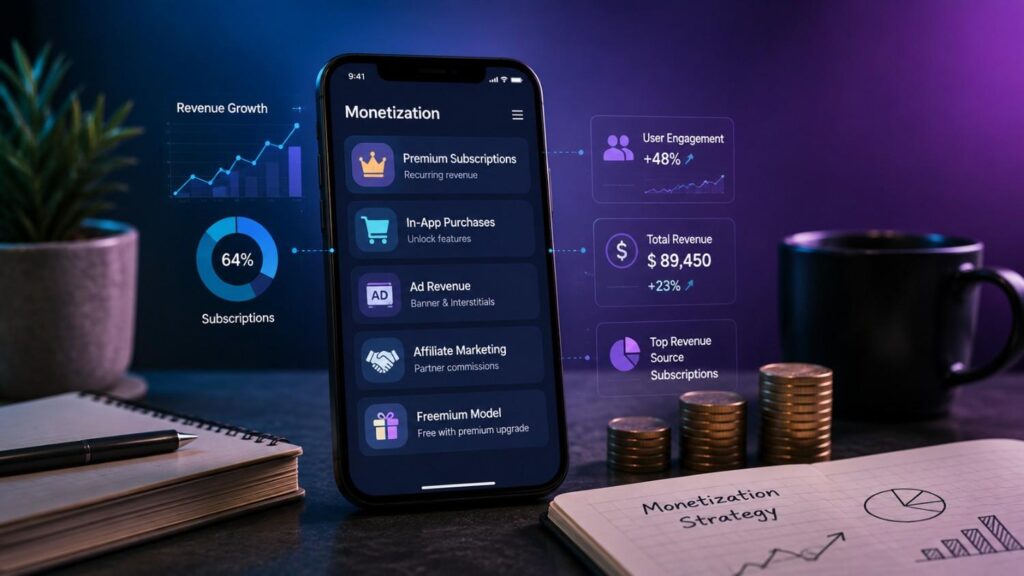
Mobile App Monetization Strategies for 2026
Building a successful mobile application requires more than attracting downloads. Downloads create an opportunity, but sustainable revenue comes from understanding what users value, when they are willing to pay, and which monetization experience feels reasonable within the product. An app can have excellent acquisition numbers and still struggle financially if users do not reach meaningful value before encountering a paywall or if advertising interrupts the experience so aggressively that retention falls.
The most effective Mobile App Monetization Strategies for 2026 therefore begin with user economics rather than with a preferred billing method. A productivity app used throughout the working week may justify recurring subscription pricing because the product continues providing value. A casual mobile game could perform better through rewarded advertising, consumable in-app purchases, or a hybrid approach. A specialized utility used only occasionally may require a one-time purchase or another model that does not ask customers to maintain a continuous subscription.
Industry research also reinforces the need to evaluate monetization more broadly. RevenueCat’s State of Subscription Apps 2026 examines more than 115,000 apps, over $16 billion in revenue, and more than one billion transactions. AppsFlyer’s 2026 monetization research also shows developers using combinations of advertising and purchase revenue across mobile categories. The important conclusion is not that every app needs multiple revenue streams. It is that modern monetization should be designed around distinct user segments, carefully measured experiments, and long-term customer value instead of simply maximizing revenue from the first session.
Which Mobile App Monetization Models Work Best in 2026?
No single mobile app revenue model is universally superior because different apps create value in different ways. A subscription can be highly effective for software that customers rely on continuously, while the same recurring charge can feel unreasonable for an app used once every few months. In-app purchases may work extremely well for games, creator products, or apps with optional digital features, whereas advertising tends to be more practical when a large percentage of users prefer free access and overall engagement is high enough to support meaningful ad inventory.
The major revenue models available in 2026 continue to include subscriptions, in-app purchases, premium access, advertising, freemium plans, and hybrid monetization. What has become more important is the relationship between these models. Developers increasingly recognize that users do not all behave economically in the same way. Some people will never purchase but may accept advertising. Others will pay for individual digital goods, while the most engaged customers may prefer a recurring subscription that removes limitations and provides additional value.
Reviewing different app monetization models can also help developers compare how subscriptions, in-app purchases, advertising, and hybrid approaches fit different product types and audiences.
Choosing between these options requires more than reviewing what competing apps charge. Product teams should evaluate user frequency, retention, purchase intent, operating costs, content cadence, feature usage, and the importance of recurring value. I recommend selecting one primary monetization engine first. Once its economics are understood, secondary revenue models can be introduced selectively where they improve total customer lifetime value without creating unnecessary complexity or weakening the core product experience.
Subscription Monetization for Ongoing Value
Subscription monetization is most effective when customers receive benefits continuously rather than paying repeatedly for access to a largely static product. Productivity software, fitness platforms, educational services, professional utilities, cloud-based tools, content libraries, and applications that require continuing updates can often justify recurring billing because users regularly receive new or ongoing value from the service.
A strong subscription structure should make the difference between free and premium access easy to understand. Monthly plans reduce commitment and can help new users test a product, while annual plans may improve revenue predictability and encourage longer customer relationships. Developers can also experiment with introductory offers, trials, feature tiers, and different plan presentations where platform rules and product economics allow them.
The challenge is that subscription revenue creates an ongoing responsibility. A user who subscribes today must continue believing that the app is worth paying for next month or next year. Product teams therefore need to monitor activation, engagement, renewal, cancellation, and feature adoption rather than focusing only on initial purchase conversion. Subscription monetization becomes sustainable when continuous billing is matched by continuous perceived value.
| Revenue Metric | What It Measures | Monetization Relevance | Optimization Focus | Business Outcome |
|---|---|---|---|---|
| Conversion Rate | Percentage of users completing a purchase or subscription | Shows effectiveness of monetization points | Paywall, pricing, messaging, and offers | More paying users |
| Average Revenue Per User | Revenue generated per user over a defined period | Indicates monetization efficiency across the user base | Pricing, segmentation, and revenue mix | Higher user-level revenue |
| Customer Lifetime Value | Expected revenue generated throughout the customer relationship | Connects monetization with long-term retention | Retention, pricing, expansion, and reactivation | Sustainable revenue growth |
| Subscription Churn | Percentage of subscribers who cancel during a period | Identifies weaknesses in recurring revenue | Product value, onboarding, pricing, and retention | More stable recurring revenue |
| Renewal Rate | Percentage of subscribers continuing after the billing period | Measures subscription durability | Product engagement and ongoing value | Stronger recurring revenue |
| Revenue Per Install | Revenue generated relative to acquired installs | Connects acquisition with monetization performance | Monetization funnel and user quality | Better acquisition economics |
| Reactivation Rate | Percentage of previously inactive users returning | Shows effectiveness of re-engagement | Lifecycle messaging and product value | Additional revenue opportunities |
In-App Purchases for Flexible Spending
In-app purchases provide users with the flexibility to pay when a particular feature, digital item, or experience becomes valuable. Mobile games frequently use consumable currencies, boosts, cosmetic items, and premium content, while non-gaming applications may sell credits, advanced tools, individual content packs, additional storage, premium filters, or permanent feature unlocks depending on the product and applicable platform rules.
The main advantage is that customers do not need to make a recurring commitment before understanding the product. A free user can explore the experience and purchase only when a specific need arises. This makes in-app purchases useful for products where spending varies significantly between customer groups. Casual users may never purchase, occasional users may buy one or two upgrades, and highly engaged customers may spend more over time.
An effective in-app purchase strategy should feel like an extension of the product rather than an artificial restriction. Basic functionality should not be intentionally frustrating simply to force payment. Instead, purchases should unlock meaningful additional value. Teams should also evaluate purchase frequency, payer conversion, average revenue per paying user, refund behavior, and the effect of purchase prompts on retention.
Advertising and Hybrid Monetization
Advertising can be an effective revenue source when an application attracts a substantial audience but only a small percentage of users are willing to pay directly. Banner, native, interstitial, rewarded, and other ad formats allow free users to contribute economic value through attention rather than purchases. The challenge is finding a level of ad exposure that creates revenue without turning normal app usage into an irritating sequence of interruptions.
Rewarded advertising can be particularly useful because the user chooses whether to participate in the exchange. Google AdMob describes rewarded ads as formats that provide in-app rewards in exchange for interacting with advertising content. In games, for example, users might voluntarily watch an ad to receive currency, continue a session, or access another benefit. This makes the transaction clearer than automatically interrupting gameplay.
Hybrid monetization combines revenue models so different audiences can contribute differently. A mobile game might serve ads to non-paying users while offering in-app purchases to high-intent players. Another app could use subscriptions for premium access while maintaining a free advertising-supported tier. Hybrid monetization works best when every revenue stream has a clearly defined user segment rather than being added simply to increase the number of ways an app can charge.
How Should You Choose the Right App Monetization Strategy?
Choosing the right revenue model begins with understanding how the product creates value. Developers often look at competitors first, but imitation can be misleading because two applications in the same category may have very different usage patterns, customer segments, acquisition economics, and operating costs. A meditation app used every morning behaves differently from a travel-planning utility opened several times per year, even though both may technically be categorized as lifestyle applications.
The first step is therefore to examine frequency and intensity of use. Determine whether customers experience value continuously, occasionally, or through isolated transactions. Next, study which features drive repeated engagement and whether particular customer segments appear willing to pay. If a small group of professional users receives significantly more value than casual users, a premium subscription tier might make sense. If most users want free access but remain highly engaged, advertising may deserve greater consideration.
Teams should then evaluate monetization against customer lifetime value rather than immediate conversion alone. A paywall can increase short-term revenue while damaging retention, just as excessive free access can produce strong engagement without a viable business model. The objective is to design a pricing structure in which customers understand why payment is requested and feel that the exchange remains fair. The table below provides a useful starting framework for comparing the main monetization approaches.
| Monetization Model | Best Fit | Main Strength | Main Risk |
|---|---|---|---|
| Subscription | Continuous-value apps | Predictable recurring revenue | Churn if ongoing value is weak |
| In-app purchases | Games, credits, upgrades | Flexible spending | Revenue may depend on a small payer segment |
| Advertising | Large free audiences | Monetizes non-paying users | Poor placement can damage UX |
| Freemium | Broad acquisition funnels | Reduces entry friction | Free tier may be too generous |
| Hybrid | Apps with varied user segments | Diversifies revenue | Added product and analytics complexity |
Match Monetization to User Value and Frequency
The first question to ask is how often a user experiences meaningful value. Applications supporting daily productivity, entertainment, learning, fitness, or professional workflows may be appropriate for subscriptions because users receive repeated benefits. By contrast, an app that solves an occasional one-time problem may struggle to justify recurring billing unless it delivers additional continuing functionality between those moments.
The second question concerns willingness to pay. Not all users value the same features equally. Casual customers may accept advertising instead of paying, while advanced users may gladly purchase premium functionality, higher limits, exclusive content, or an ad-free experience. Segmenting users by engagement and feature usage can reveal monetization opportunities that a single universal paywall might overlook.
I recommend observing product behavior before aggressively monetizing an early-stage app. Activation rates, session frequency, retention, and feature adoption show where customers experience real value. Monetization performs more naturally when purchase opportunities appear near these high-value moments. Charging users before they understand the benefit of the product can reduce conversion and create unnecessary friction during onboarding.
Know When Hybrid Monetization Makes Sense
Hybrid monetization becomes useful when an app serves several economically different user groups. A game may contain millions of players who never make purchases but are comfortable viewing optional rewarded ads, while a smaller group spends money on premium items. A content application might maintain a free advertising-supported experience while offering a paid subscription that removes ads and unlocks premium features.
Industry research illustrates why this model deserves attention. AppsFlyer’s 2026 monetization research shows that mobile gaming revenue strategies differ substantially across categories, with various combinations of in-app purchases, advertising, and hybrid approaches. These patterns demonstrate that even closely related products can monetize users in different ways depending on engagement, genre, audience expectations, and purchase behavior.
The disadvantage is operational complexity. Multiple revenue models require separate analytics, product logic, customer support processes, pricing decisions, and potentially additional billing or advertising infrastructure. Before adding a second model, teams should define which customer segment it serves and which metric should improve. If the business cannot clearly explain the purpose of an additional revenue stream, the added complexity may outweigh the potential benefit.
How Can You Increase Mobile App Revenue Without Hurting Retention?
Increasing revenue does not require making the product more aggressive. In many cases, excessive paywalls, constant advertisements, and repeated upgrade prompts reduce user satisfaction and shorten customer lifetime. Sustainable monetization focuses on improving the relationship between value creation and payment rather than simply increasing the number of monetization opportunities displayed throughout the interface. The strongest growth usually comes from improving the entire customer journey instead of optimizing a single purchase screen in isolation.
A broader review of monetization strategies also highlights the importance of aligning pricing, user experience, and revenue models rather than optimizing a single conversion point.
That journey begins with acquisition and onboarding but continues through activation, first value, purchase consideration, conversion, renewal, retention, reactivation, and expansion. Subscription applications need to understand why customers renew or cancel. Ad-supported apps need to determine how advertising affects session frequency and retention. In-app purchase businesses should analyze which items encourage spending without creating unfair or frustrating product mechanics. Each revenue model therefore requires its own combination of behavioral and financial metrics.
Teams should track conversion rate, average revenue per user, lifetime value, churn, renewal rate, payer conversion, revenue per install, and retention alongside product-engagement data. A change that raises immediate revenue while reducing long-term engagement may not actually improve the business. The objective is to find monetization improvements that increase both customer value and business value. Pricing, packaging, paywalls, onboarding, and retention programs should therefore be treated as connected parts of the same revenue system.
Improve Pricing, Packaging, and Paywalls
Pricing is not only a financial decision; it is also part of product communication. Users need to understand what they receive, why the paid experience is better, and whether the price corresponds to the value being offered. An effective paywall presents benefits clearly, avoids unnecessary complexity, and gives customers enough context to make an informed decision without relying on manipulative urgency or confusing plan structures.
Pricing experiments should isolate meaningful variables whenever possible. Teams can compare monthly and annual plan presentation, different feature bundles, trial structures, introductory offers, paywall timing, or the order in which benefits are displayed. If several elements change simultaneously, it becomes difficult to determine which modification caused the improvement or decline in conversion.
Most importantly, experiments should be measured beyond the initial purchase. A deeply discounted offer may produce more trial starts but attract users who cancel quickly. A higher-priced plan could convert fewer people but generate stronger long-term value among customers who truly need the product. Evaluate retention, renewal, refunds, and lifetime value so pricing decisions support durable revenue rather than short-lived conversion gains.
| Monetization Model | Ideal App Type | Primary Revenue Mechanism | Key User Value | Main Revenue Advantage | Main Challenge |
|---|---|---|---|---|---|
| Subscription | Productivity, fitness, education, professional apps | Recurring monthly or annual payments | Continuous access and ongoing benefits | Predictable recurring revenue | Subscription churn |
| In-App Purchases | Games, digital-content, utility apps | Individual purchases of goods, upgrades, or features | Optional premium functionality | Flexible spending opportunities | Smaller percentage of users may pay |
| Advertising | Free apps with large active audiences | Ad impressions, interactions, or rewarded engagement | Free access to core features | Monetizes non-paying users | Excessive ads can reduce retention |
| Freemium | Consumer and utility apps | Free core experience with paid upgrades | Low-friction product access | Larger acquisition funnel | Free users may not convert |
| Hybrid | Apps with multiple user segments | Combination of subscriptions, ads, and purchases | Multiple ways to access value | Revenue diversification | Higher operational complexity |
Treat Retention as a Monetization Strategy
Retention is one of the most important components of mobile app revenue because a customer who remains engaged can create considerably more value than one who converts once and disappears. This is especially true for subscription products, where recurring revenue depends on users continuing to believe the app deserves a place in their monthly or annual spending.
Improving retention starts with helping customers experience the core product benefit quickly and repeatedly. Onboarding should guide users toward valuable actions rather than simply explaining features. Lifecycle messaging can remind customers about unused capabilities, unfinished progress, new content, or benefits they may have overlooked. Cancellation surveys and renewal behavior can also reveal whether pricing, product quality, expectations, or competitive alternatives are driving churn.
RevenueCat’s subscription research emphasizes metrics such as realized lifetime value, active renewal rate, reactivation, and revenue per install because subscription performance extends well beyond the initial transaction. Monetization and retention teams should therefore work closely together. The most successful revenue strategy often comes from increasing the number of users who continue receiving value rather than simply increasing the percentage who pay immediately.
Related Articles
How Are App Store Payment Changes Affecting Monetization in 2026?
App-store payment strategy has become increasingly complex because billing rules no longer behave identically across every region and storefront. Developers must consider not only the type of digital product being sold but also where the customer is located, which platform distributes the application, which purchase flow is being used, and whether alternative billing or external payment options are permitted under current policies. This makes payment architecture a strategic consideration rather than a technical detail handled shortly before launch.
Apple continues to maintain detailed requirements around digital purchases, subscriptions, external links, and in-app payment functionality. Its App Review Guidelines define circumstances in which In-App Purchase is required and circumstances in which external purchase communications may be permitted. These rules can differ depending on storefront and app category. Developers should therefore check the current documentation rather than relying on general advice written for another region or an older version of the policy.
Google Play is likewise operating region-specific programs involving billing alternatives and external purchase options. Some of these frameworks include distinct requirements, reporting responsibilities, fees, and implementation conditions. The broader implication is that developers can no longer design one global checkout strategy based solely on technical convenience. Monetization planning should include regional policy review, payment economics, tax handling, refund processes, customer support, and ongoing monitoring of platform-policy changes.
Consider Web-to-App Monetization Carefully
Web-to-app monetization allows customers to move from a website into an application or complete certain account and purchase activities outside the native app environment where permitted. This approach can give developers greater control over checkout design, customer relationships, pricing experimentation, promotional campaigns, and payment infrastructure. It can therefore become an important part of a broader mobile revenue strategy for some businesses.
However, external payment options are governed by platform-specific and region-specific policies. A flow that is permitted in one storefront may require different implementation elsewhere or may not be allowed at all. Developers must understand current Apple App Store and Google Play rules before adding purchase links, external checkout messaging, or alternative payment systems.
The economics also need careful evaluation. Avoid assuming that an external checkout automatically produces higher margins. Payment processing, taxes, refunds, support costs, store-related fees where applicable, customer trust, and conversion differences can materially change the outcome. A web-to-app strategy should be tested using complete unit economics and user behavior rather than selected transaction costs alone.
Keep Store Compliance Part of Revenue Planning
Store compliance should be included at the beginning of monetization planning because payment rules affect product design, user flows, analytics, and customer support. If a team designs a complex subscription experience and discovers shortly before launch that its payment flow conflicts with store requirements, substantial engineering and design work may need to be repeated.
Developers are also responsible for understanding how third-party services interact with platform policies. Advertising SDKs, analytics providers, billing libraries, subscription tools, and external checkout systems can all affect an app’s compliance posture. Product teams should maintain documentation showing which technologies are used, what data they handle, and which revenue flows they support.
A practical compliance process includes scheduled reviews of Apple and Google documentation, regional payment maps, restoration testing, subscription-management checks, and clear refund procedures. Teams should know which purchase methods are available in each market and how customers can manage their transactions. Treating compliance as an ongoing operational responsibility reduces the risk that revenue growth will depend on a billing flow that later needs urgent redesign.
Quick Answer About Mobile App Monetization Strategies for 2026
The strongest Mobile App Monetization Strategies for 2026 are built around how, when, and why users receive value from an app. Subscriptions are effective when an app delivers continuing benefits, while in-app purchases are better suited to optional digital items, premium features, consumable credits, or one-time upgrades. Advertising can monetize large free audiences, and hybrid monetization can combine two or more revenue streams when an app serves users with different levels of engagement and willingness to pay.
The key shift is that app developers increasingly need to think beyond a single transaction. Successful mobile app monetization now involves the entire user lifecycle, including onboarding, activation, paywall timing, purchase conversion, subscription renewal, retention, reactivation, and customer lifetime value. RevenueCat’s 2026 subscription-app research covers more than 115,000 apps and over $16 billion in revenue, while AppsFlyer’s 2026 monetization research highlights continued use of mixed advertising and purchase models across app categories.
The practical lesson is to avoid choosing a revenue model only because competitors use it. Instead, analyze how frequently users return, what features they value most, which segments are willing to pay, and how monetization affects retention. A simpler model with strong product-market fit usually performs better than an overly complicated system filled with subscriptions, ads, purchases, and upsells that do not correspond to real customer value.
Frequently Asked Questions About Mobile App Monetization Strategies for 2026
Questions about mobile app monetization often appear simple, but the right answer depends heavily on product category, user behavior, geographic market, and business model. Founders frequently ask whether subscriptions are better than advertisements, whether a free app can generate meaningful revenue, or whether every successful product should eventually adopt hybrid monetization. In reality, the strongest model is the one that reflects how customers already receive and perceive value.
Another important factor is timing. Monetization decisions should evolve as the product matures. An early-stage app may initially focus on retention and product-market fit before introducing more sophisticated pricing, while an established application may already have enough behavioral data to segment users and test different revenue paths. Decisions made at launch do not necessarily need to remain permanent if later evidence reveals a better model.
The following frequently asked questions address the most common concerns around Mobile App Monetization Strategies for 2026. They cover subscriptions, in-app purchases, advertising, hybrid revenue, rewarded ads, and revenue optimization. Each answer should be viewed as a strategic starting point rather than a universal rule. The correct implementation depends on the product’s economics, customer expectations, platform policies, and measured performance.
What Is the Best Way to Monetize a Mobile App in 2026?
There is no single best way to monetize every mobile app. Subscription models are most appropriate when users receive ongoing value, while in-app purchases work well for optional digital goods, premium functionality, or consumable credits. Advertising can monetize large free audiences, and hybrid models allow different customer groups to contribute through different revenue mechanisms.
The best choice depends on product frequency, engagement, customer willingness to pay, content or service costs, acquisition economics, and retention. A daily professional tool and an occasional entertainment app should not automatically use the same pricing model simply because both are distributed through mobile app stores.
Start by identifying when users experience their strongest value moment and how often that moment occurs. Then test the simplest revenue model that captures part of that value while preserving the experience. Add secondary monetization only after the core economics are understood.
How Do Free Mobile Apps Make Money?
Free mobile apps can generate revenue through several models without charging users at the point of installation. Common approaches include advertising, in-app purchases, premium upgrades, subscriptions, commissions, sponsored placements, or combinations of these revenue streams. The free download functions as an acquisition mechanism rather than proof that the entire product must remain free.
Advertising is particularly useful when an app has strong engagement but low direct purchase intent. In-app purchases allow individual users to pay for digital features or content, while freemium models keep basic functionality available at no cost and reserve advanced capabilities for paying customers.
The important consideration is whether the free experience supports conversion or engagement without becoming economically unsustainable. If the free tier contains almost everything valuable, users may have little reason to pay. If it is too restricted, potential customers may leave before understanding the product. A good free experience demonstrates value while creating a logical path toward monetization.
Are Subscriptions Better Than In-App Purchases?
Subscriptions are not automatically better than in-app purchases because they solve different monetization problems. Subscriptions are ideal when an app delivers ongoing services, regularly updated content, continuing access, or persistent professional value. They provide recurring revenue but require developers to maintain enough ongoing value to justify repeated billing.
In-app purchases are often more suitable when spending occurs around individual features, consumable items, digital goods, or occasional upgrades. They allow users to spend flexibly without committing to a recurring charge and can support wide differences in purchasing behavior between casual and highly engaged customers.
Some products can combine both approaches effectively. For example, a subscription could provide premium access while individual purchases cover optional credits or specialized content where platform rules permit. The decision should be based on customer value patterns, not on the assumption that recurring billing is inherently superior.
What Is Hybrid App Monetization?
Hybrid app monetization means generating revenue through more than one model. Common combinations include advertising plus in-app purchases, advertising plus subscriptions, or subscriptions alongside optional digital purchases. This approach allows an app to monetize several customer segments rather than requiring every user to behave economically in the same way.
A free user may contribute through advertising, while another customer pays to remove ads. A highly engaged user could purchase additional content or subscribe to a premium plan. This flexibility can improve total revenue if each option corresponds to a genuine difference in customer behavior.
The risk is complexity. Hybrid products require more analytics, billing logic, pricing decisions, and user-experience design. Teams should introduce additional models only when they can identify the user segment being served and measure whether the change improves lifetime value without harming retention.
Are Rewarded Ads Good for Mobile Apps?
Rewarded ads can be effective when users understand the value exchange and participation remains voluntary. Instead of interrupting an experience automatically, the app offers a benefit in return for engaging with an advertisement. Common rewards include virtual currency, extra attempts, temporary boosts, premium content access, or another digital benefit relevant to the product.
The format is particularly common in mobile games because rewards can be integrated naturally into progression systems. However, rewarded ads can also be considered in other applications when the benefit feels appropriate and does not undermine paid offerings.
The quality of implementation matters. Rewards should be valuable enough to motivate participation but not so generous that users lose interest in purchases or subscriptions. Developers should track ad engagement, retention, payer conversion, and overall revenue to determine whether rewarded advertising strengthens or weakens the wider monetization model.
How Can I Increase Mobile App Revenue?
Start by examining the entire monetization funnel rather than simply raising prices. Revenue can often improve through better onboarding, clearer paywalls, stronger activation, improved feature packaging, more effective trials, higher renewal rates, better retention, reactivation campaigns, or more appropriate monetization for previously unmonetized user segments.
Measure changes using lifetime value as well as immediate conversion. A paywall experiment that creates more purchases may still be harmful if those customers cancel quickly or if the change reduces overall retention. Similarly, increasing advertising frequency can raise short-term revenue while pushing users away from the app.
The strongest revenue improvements usually come from aligning monetization with customer value. Determine which actions signal high intent, what benefits drive repeated use, and why customers cancel or stop engaging. Optimizing those fundamentals can increase revenue without making the app feel more aggressive.
Conclusion
The most effective Mobile App Monetization Strategies for 2026 are based on a simple principle: users should understand the value they receive and why payment is being requested. Subscriptions can build recurring revenue when an app delivers ongoing benefits, in-app purchases provide flexible spending opportunities, advertising monetizes users who prefer free access, and hybrid models can serve different economic segments within the same product. None of these approaches succeeds simply because it is technically available.
Developers should therefore evaluate monetization through the entire user lifecycle. Strong onboarding helps people reach value faster, good pricing and packaging make paid benefits understandable, thoughtful paywalls improve conversion, and retention determines whether subscription revenue becomes sustainable. Advertising and in-app purchases require similar discipline because aggressive monetization can increase short-term revenue while reducing long-term engagement and customer lifetime value.
Platform policies add another important layer. Billing rules and external payment options can vary by region, meaning monetization design now requires ongoing policy awareness alongside product strategy. Teams that combine user research, controlled experimentation, reliable analytics, retention analysis, and compliance review are better positioned to build durable revenue. Sustainable monetization is not about extracting the maximum amount from every user. It is about creating an exchange where customers continue receiving enough value to remain engaged and, where appropriate, continue paying.
The Main Takeaway
Start with user behavior rather than a preferred monetization model. Understand how often customers use the product, which features create the strongest outcomes, how retention changes over time, and where willingness to pay appears. These signals provide a stronger foundation than simply copying the pricing structure of a successful competitor.
Choose the simplest revenue model that captures value without creating unnecessary friction. A subscription may be appropriate for continuous benefits, while purchases or advertising may work better for episodic usage. Hybrid monetization should be introduced only when different user segments genuinely require different revenue paths.
Finally, evaluate monetization through customer lifetime value rather than immediate conversion alone. A strategy is successful when customers continue receiving value, retention remains healthy, and revenue becomes more predictable. Long-term economics should guide pricing, paywalls, advertising, and product investment.
What App Developers Should Do Next
Begin with a complete monetization audit. Map the customer journey from installation through onboarding, activation, first value, paywall exposure, purchase, renewal, cancellation, and possible reactivation. Identify where users stop progressing and whether those points reflect weak product value, unclear pricing, technical friction, or poorly timed monetization.
Next, choose one meaningful experiment rather than changing everything at once. This might involve paywall copy, annual-plan presentation, rewarded advertising, a new premium bundle, trial structure, or a limited hybrid monetization test. Define the expected outcome and the metrics that will determine whether the experiment genuinely improves performance.
Finally, review current Apple App Store and Google Play billing requirements in every market where the app operates. Payment policies can influence which monetization flows are possible and how they must be implemented. Combining experimentation with compliance discipline helps ensure that revenue growth remains sustainable rather than dependent on fragile or outdated billing assumptions.