
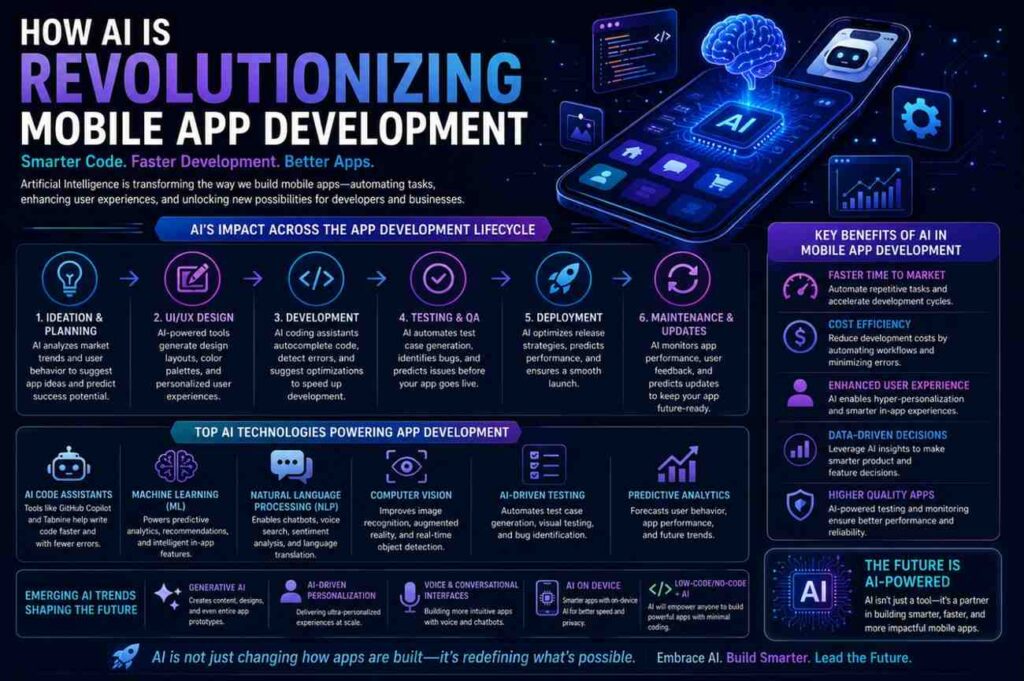
How AI is Revolutionizing Mobile App Development
Artificial Intelligence is fundamentally reshaping how mobile applications are designed, developed, and optimized. In today’s digital landscape, the question of how AI is revolutionizing mobile app development is no longer a future prediction—it is a present-day reality. From automating repetitive coding tasks to enabling highly personalized user experiences, AI has become one of the most transformative technologies in the mobile development industry. Businesses of all sizes are leveraging AI to build smarter, faster, and more efficient applications that meet the growing expectations of modern users.
Traditional app development often required extensive manual effort across planning, coding, testing, deployment, and maintenance. Today, AI-powered tools are streamlining these processes by assisting developers with code generation, bug detection, performance optimization, and automated testing. This not only accelerates development timelines but also improves software quality and reduces operational costs. As a result, development teams can focus more on innovation and user experience rather than repetitive technical tasks.
Another major impact of AI is its ability to create intelligent and adaptive applications. Modern mobile apps can analyze user behavior, learn preferences, and deliver personalized experiences in real time. Features such as recommendation engines, predictive search, intelligent chatbots, voice assistants, and behavioral analytics are now becoming standard across many industries. These capabilities help businesses increase engagement, improve customer satisfaction, and build stronger relationships with their users.
As AI technology continues to evolve, its role in mobile app development will only become more significant. Future applications are expected to become increasingly autonomous, context-aware, and capable of making intelligent decisions without constant human intervention.
Understanding AI in Mobile App Development
Artificial Intelligence in mobile app development refers to the use of advanced technologies such as machine learning, deep learning, natural language processing, and computer vision to improve how mobile applications are built and how they function. Instead of relying entirely on static programming and predefined rules, AI enables applications to learn from data, automate processes, and adapt to user behavior over time. This creates more intelligent, efficient, and personalized digital experiences.
As mobile applications become more complex and user expectations continue to rise, AI is helping developers streamline development workflows while also enhancing application performance. From automated coding assistance to predictive analytics and intelligent user interactions, AI is becoming a core component of modern app development strategies. Its ability to combine automation with adaptability is changing how developers approach both the creation and maintenance of mobile applications.
What Makes AI Different from Traditional Development
Traditional mobile app development depends heavily on developers manually writing, testing, and maintaining code. Every feature must be designed, implemented, and optimized through human effort, which can be time-consuming and resource-intensive. AI introduces a fundamentally different approach by providing intelligent assistance throughout the development lifecycle, helping teams work faster and more efficiently.
AI-powered development tools can suggest code snippets, identify bugs in real time, generate functions automatically, and optimize application performance. These capabilities significantly reduce repetitive work and allow developers to focus on higher-level tasks such as system architecture, user experience, and business logic. Rather than replacing developers, AI acts as a collaborative tool that enhances productivity and improves overall software quality.
Another key distinction is adaptability. Traditional applications operate based on predefined rules and logic, meaning they only behave as programmed. AI-powered systems, however, can analyze data, learn from user interactions, and continuously improve their performance. This allows mobile applications to become more responsive, personalized, and capable of handling changing user needs without constant manual updates.
Core Technologies Behind AI Apps
AI-powered mobile applications are built on several foundational technologies that work together to create intelligent functionality. Machine learning is one of the most important components, enabling applications to analyze data, identify patterns, and improve performance over time based on user behavior and real-world usage. This technology powers features such as recommendation engines, predictive analytics, and personalized content delivery.
Natural language processing (NLP) allows applications to understand, interpret, and respond to human language. It is the technology behind chatbots, virtual assistants, voice search, and real-time language translation. By enabling more natural communication between users and applications, NLP significantly improves user engagement and accessibility.
Computer vision is another critical technology that enables mobile apps to process and understand visual information. Features such as facial recognition, object detection, image classification, and augmented reality experiences rely on computer vision algorithms. These capabilities are widely used in industries such as healthcare, retail, social media, and security.
In addition, generative AI is becoming increasingly important in modern mobile development. Generative models can create code, design user interfaces, generate content, and automate various creative tasks. Combined with machine learning, NLP, and computer vision, generative AI is helping developers build smarter, more capable applications while accelerating development timelines and reducing operational complexity.
How AI is Transforming the App Development Lifecycle
Artificial Intelligence is transforming the entire mobile app development lifecycle by introducing automation, predictive analysis, and intelligent decision-making at every stage. From initial planning and design to coding, testing, deployment, and maintenance, AI is helping development teams work faster, reduce costs, and improve software quality. Instead of relying solely on manual processes, organizations are increasingly using AI-powered tools to streamline workflows and accelerate product delivery.
This transformation is changing how applications are built and maintained in the modern digital environment. AI not only improves development efficiency but also enables teams to create smarter, more personalized, and highly optimized applications. As a result, developers can spend more time focusing on innovation and user experience while AI handles many repetitive and time-consuming tasks.
| Development Stage | AI Role in the Process | Key Output / Benefit | Tools / Technologies Involved |
|---|---|---|---|
| Planning & Research | Analyzes user behavior and market trends to guide app structure | Better product strategy and feature selection | Machine learning models, predictive analytics systems |
| UI/UX Design | Generates layout suggestions based on user engagement data | Improved usability and higher engagement rates | AI design tools, UX optimization engines |
| Coding & Development | Assists in writing code, debugging, and optimization | Faster development cycles and fewer errors | AI code assistants, generative AI systems |
| Testing & QA | Automates testing scenarios and detects bugs | Higher stability and reduced manual testing effort | Automated testing frameworks, AI debugging tools |
| Deployment & Monitoring | Tracks app performance and predicts failures | Real-time optimization and performance stability | AI monitoring systems, cloud intelligence platforms |
AI in Planning and UI/UX Design
AI is playing an increasingly important role in the planning and design phases of mobile app development. By analyzing user behavior, market trends, and engagement metrics, AI helps developers make informed decisions about app structure, functionality, and user experience. These insights allow teams to identify what users want and design applications that better meet their expectations.
Modern AI-powered design tools can recommend optimal layouts, navigation structures, button placements, and color schemes based on proven user interaction patterns. This data-driven approach reduces guesswork and helps create interfaces that are both visually appealing and highly functional. Designers can quickly test multiple concepts and receive intelligent recommendations that improve usability and engagement.
AI-driven design systems also enhance accessibility and responsiveness across different devices and screen sizes. By automatically adjusting layouts and identifying potential usability issues, these tools enable developers to create more inclusive and user-friendly experiences. As a result, the design process becomes faster, more efficient, and more focused on delivering value to end users.
AI in Coding and Development
AI is significantly changing how developers write and manage code by automating many repetitive programming tasks. Modern AI coding assistants can generate code from natural language instructions, suggest functions, complete code blocks, and even create application components automatically. This helps developers accelerate development while reducing manual effort and coding errors.
These tools are particularly valuable for generating APIs, backend structures, database queries, and user interface components. Instead of building everything from scratch, developers can use AI-generated foundations and then customize them according to project requirements. This approach improves productivity and allows teams to deliver applications more quickly.
Beyond code generation, AI also helps optimize software quality by identifying inefficient logic, redundant code, and potential security vulnerabilities. Intelligent code analysis tools continuously review projects and recommend improvements that enhance performance, maintainability, and security. This leads to cleaner, more scalable applications that are easier to manage over time.
AI in Testing and Debugging
Testing and debugging are among the most time-consuming aspects of mobile app development, and AI is helping automate many of these processes. AI-powered testing tools can simulate real-world user interactions, automatically generate test cases, and identify issues across different devices, operating systems, and usage scenarios. This enables broader test coverage while significantly reducing manual testing effort.
By continuously monitoring application behavior, AI can detect bugs, performance bottlenecks, and security vulnerabilities much earlier in the development cycle. Early detection reduces the cost of fixing issues and helps prevent problems from reaching end users. This results in more stable and reliable applications at launch.
AI-based debugging systems further improve efficiency by analyzing logs, tracing error patterns, and pinpointing the root causes of technical issues. Instead of spending hours searching through large volumes of code and diagnostic data, developers receive intelligent recommendations that accelerate troubleshooting. As applications become increasingly complex, AI-driven testing and debugging tools are becoming essential for maintaining performance, security, and overall software quality.
Benefits of AI in Mobile App Development
AI significantly enhances the overall efficiency of mobile app development by improving speed, accuracy, and cost-effectiveness. Tasks that traditionally required weeks of manual effort, such as coding, testing, and debugging, can now be completed in a fraction of the time using AI-powered tools. This allows development teams to deliver high-quality applications faster and more efficiently.
In addition to speed, AI helps reduce human errors in coding and testing, leading to more stable and reliable applications. Automated testing systems can detect bugs, performance issues, and security vulnerabilities early in the development process. As a result, businesses benefit from lower development costs, reduced maintenance efforts, and improved software quality.
AI also plays a major role in enhancing user engagement through personalization. By analyzing user behavior, preferences, and interaction patterns, AI systems can deliver tailored content, recommendations, and app experiences. This continuous learning capability allows applications to evolve in real time, ensuring they remain relevant, engaging, and user-friendly over time.
Generative AI and Its Role in App Creation
Generative AI is becoming one of the most transformative technologies in modern mobile app development. Unlike traditional development tools that require manual coding and design work, generative AI can create content, code, interfaces, and workflows based on simple user instructions. This capability significantly reduces development time and allows teams to move from idea to implementation much faster than before.
As AI models continue to improve, they are becoming valuable assistants throughout the app creation process. From generating code and designing prototypes to automating repetitive development tasks, generative AI helps developers focus on strategic problem-solving and innovation. While it does not replace human expertise, it serves as a powerful productivity tool that accelerates software development and improves efficiency.
AI Code Generation
AI code generation allows developers to describe application features in natural language and receive functional code almost instantly. Modern AI development assistants can generate frontend components, backend logic, database queries, APIs, and even entire application structures based on simple prompts. This dramatically reduces the time required for routine programming tasks.
By automating repetitive coding activities, developers can focus more on architecture, optimization, and business logic rather than writing boilerplate code. This improves productivity and enables smaller teams to accomplish more within shorter development cycles. AI-generated code also helps beginners learn programming concepts by providing examples and implementation guidance.
However, AI-generated code should not be accepted without review. Developers must verify functionality, performance, and security before deployment. Human oversight remains essential to ensure that generated code meets project requirements and follows industry best practices.
AI-Powered App Prototyping
AI-powered prototyping tools enable development teams to transform ideas into interactive wireframes and design concepts within minutes. Instead of spending days creating initial mockups manually, designers can use AI to generate layouts, user flows, and interface elements based on project requirements and user goals.
This rapid prototyping capability helps teams validate ideas earlier in the development process. Stakeholders can review concepts quickly, provide feedback, and identify improvements before significant resources are invested in full-scale development. As a result, businesses can reduce risk and improve decision-making during product planning.
AI also enables faster design iteration by analyzing user feedback and recommending interface improvements. Teams can continuously refine their prototypes using real-time insights, resulting in more user-friendly applications and a more efficient product development process overall.
Limitations of Generative AI
Despite its impressive capabilities, generative AI still has limitations that developers must consider. AI models can sometimes generate incorrect logic, inefficient code, outdated implementations, or incomplete application structures. These issues may not always be immediately obvious and can create problems if not carefully reviewed.
Another challenge is that AI lacks deep contextual understanding of highly complex systems, unique business requirements, and long-term architectural considerations. While it can generate useful solutions for many tasks, it may struggle with specialized scenarios that require domain expertise and strategic decision-making.
For these reasons, developer oversight remains critical throughout the development process. Generative AI should be viewed as an assistant rather than a replacement for skilled professionals. By combining AI-generated outputs with human expertise, organizations can maximize productivity while maintaining high standards of quality, security, and reliability.
Machine Learning in Mobile Applications
Machine learning has become one of the most important technologies driving innovation in modern mobile applications. By enabling apps to learn from data and improve over time, machine learning allows developers to create experiences that are more personalized, intelligent, and adaptive. Rather than relying solely on predefined rules, machine learning systems continuously analyze user behavior and make data-driven adjustments to improve performance.
Today, machine learning powers a wide range of mobile app features, including recommendation engines, predictive analytics, voice recognition, image classification, fraud detection, and personalized content delivery. As mobile applications generate and process increasing amounts of data, machine learning plays a critical role in transforming that information into actionable insights and intelligent functionality.
Predictive Analytics in Apps
Predictive analytics is one of the most valuable applications of machine learning in mobile development. By analyzing historical user data and behavioral patterns, machine learning models can predict future actions and preferences. This enables applications to recommend products, content, services, or features that users are most likely to engage with.
For example, e-commerce apps use predictive analytics to suggest products based on browsing and purchase history, while streaming platforms recommend movies, music, and videos tailored to individual preferences. These personalized experiences improve user satisfaction, increase engagement, and encourage longer app usage.
Beyond personalization, predictive analytics also supports business decision-making. Organizations can use machine learning insights to forecast demand, identify customer trends, and optimize marketing strategies. This data-driven approach helps businesses improve conversion rates and gain a competitive advantage in rapidly changing markets.
Real-Time Decision Making
Machine learning enables mobile applications to make intelligent decisions in real time by analyzing incoming data and responding instantly to changing conditions. This capability is particularly important in environments where speed and accuracy directly impact user experience and operational efficiency.
Navigation applications, for example, continuously analyze traffic conditions and adjust routes based on real-time congestion data. Financial applications use machine learning to identify suspicious transactions instantly and flag potential fraud before significant damage occurs. Similarly, ride-sharing and delivery platforms optimize routes and resource allocation using real-time predictive models.
By processing data as events occur, machine learning helps applications become more responsive, adaptive, and reliable. This ability to make rapid, data-driven decisions improves performance and ensures users receive timely and relevant information when they need it most.
Data Requirements for ML Models
The effectiveness of machine learning models depends heavily on the quality and quantity of data available for training and analysis. Machine learning systems require large, clean, and well-structured datasets to identify meaningful patterns and generate accurate predictions. Without sufficient data, model performance can be limited and unreliable.
Poor-quality data can introduce errors, bias, and inconsistencies that negatively impact results. Incomplete records, duplicate entries, inaccurate information, and outdated datasets can all reduce the accuracy of machine learning predictions and weaken overall application performance. This is why data preparation and management are critical components of any machine learning project.
To achieve the best results, organizations must invest in proper data collection, cleaning, validation, and governance practices. High-quality data not only improves prediction accuracy but also enables machine learning systems to adapt more effectively to user behavior and changing market conditions, ultimately creating smarter and more reliable mobile applications.
AI-Powered Mobile App Features
AI-powered mobile app features are transforming how users interact with digital applications by making them more intelligent, responsive, and personalized. Instead of offering static experiences, modern apps now adapt dynamically to user behavior, preferences, and real-time inputs. This shift is improving usability, engagement, and overall user satisfaction across industries such as e-commerce, healthcare, finance, and entertainment.
As AI technologies continue to evolve, mobile applications are increasingly integrating advanced capabilities such as chatbots, voice assistants, natural language processing, and personalized user interfaces. These features not only enhance functionality but also reduce friction in user interactions, allowing apps to deliver faster and more meaningful experiences.
| AI Feature Area | Function in Mobile Apps | User Experience Impact | Business Value |
|---|---|---|---|
| Chatbot Systems | Automates customer support and interaction | Instant responses and 24/7 assistance | Reduces support cost and workload |
| Voice Recognition | Enables voice-based commands and navigation | Hands-free and faster interaction | Improves accessibility and engagement |
| Predictive Analytics | Predicts user actions and preferences | Personalized recommendations | Increases retention and conversions |
| AI UX Personalization | Customizes interface based on user behavior | Highly personalized app experience | Boosts user satisfaction and loyalty |
| Intelligent Notifications | Sends smart alerts based on user activity patterns | Relevant and timely updates | Improves user engagement rates |
Chatbot Integration in Apps
AI-powered chatbots have become a standard feature in modern mobile applications, providing instant support and improving user engagement without the need for human intervention. These chatbots can handle customer queries, guide users through app features, and assist with transactions or troubleshooting in real time.
In addition to basic support functions, advanced chatbots use machine learning and natural language processing to understand user intent and provide more accurate and contextual responses. This makes interactions feel more natural and human-like, significantly improving the overall user experience.
Businesses benefit greatly from chatbot integration as it reduces operational costs, ensures 24/7 availability, and increases customer satisfaction. Over time, chatbots can also learn from previous interactions, allowing them to continuously improve their responses and effectiveness.
Voice Recognition and NLP
Voice recognition technology enables users to interact with mobile applications using natural speech instead of manual input, making apps more accessible and convenient. This feature is especially useful in hands-free environments such as driving, cooking, or multitasking.
Natural Language Processing (NLP) complements voice recognition by allowing applications to understand the meaning, context, and intent behind user commands. Together, these technologies enable users to perform complex tasks through simple voice instructions, such as searching, sending messages, or controlling smart devices.
As NLP models become more advanced, voice-based interactions are becoming increasingly accurate and responsive. This is helping mobile applications move closer to natural human communication, improving usability for a wide range of users, including those with accessibility needs.
AI UX Personalization
AI-driven UX personalization allows mobile applications to adapt their interface, content, and features based on individual user behavior and preferences. By analyzing data such as usage patterns, interaction history, and engagement metrics, AI can create highly customized user experiences.
For example, apps can reorder menus, highlight frequently used features, or recommend content tailored to user interests. This level of personalization helps users navigate applications more easily and increases overall engagement and retention.
Over time, AI systems continue to learn and refine personalization strategies, making the user experience more intuitive and efficient. This results in mobile applications that feel uniquely designed for each user, significantly enhancing satisfaction and long-term usability.
Comparison of Traditional vs AI-Powered App Development
| Feature | Traditional Development | AI-Powered Development |
|---|---|---|
| Speed | Slow | Fast |
| Testing | Manual | Automated |
| UX Design | Static | Adaptive |
| Cost | Higher | Lower |
| Scalability | Limited | High |
Challenges of AI in Mobile App Development
AI in mobile app development introduces significant advantages, but it also comes with important challenges that developers and organizations must carefully manage. One of the biggest concerns is data privacy, as AI systems require large amounts of user data to function effectively. This raises issues around data collection, storage, consent, and compliance with privacy regulations, especially in sensitive industries like healthcare and finance.
Another challenge is the potential over-reliance on automation. While AI can significantly speed up development and improve efficiency, excessive dependence on automated systems may reduce developer control and limit human oversight. This can lead to issues in code quality, architectural decisions, and long-term maintainability if not properly managed.
In addition, there is a growing skills gap in the industry. Many developers are still in the process of learning how to effectively use AI tools, machine learning frameworks, and generative systems. This creates a learning curve that requires continuous training, upskilling, and adaptation to new technologies, which can slow down adoption in some organizations.
Future of AI in Mobile App Development
The future of AI in mobile app development is expected to be shaped by increased automation, accessibility, and intelligence across the entire development lifecycle. One major trend is the rise of no-code and low-code platforms, which will allow non-developers to build functional applications using AI-driven tools. This will significantly reduce the barrier to entry and accelerate digital product creation.
Another key development is hyper-personalization, where mobile applications will adapt in real time to individual user behavior, preferences, and context. Instead of offering generic experiences, apps will dynamically adjust interfaces, content, and functionality to match each user’s needs, creating highly tailored digital experiences.
As AI technology continues to advance, it is expected that intelligent systems will take on a larger role in app development itself, from planning and coding to testing and deployment. This will lead to highly adaptive, self-improving applications that require minimal manual intervention, fundamentally transforming how mobile apps are built and maintained in the future.
Frequently Asked Questions
Frequently asked questions provide quick and clear answers to the most common queries about AI in mobile app development. This section helps readers understand key concepts without needing to go through the entire guide, making it especially useful for beginners and decision-makers who want fast insights.
In the context of AI-powered app development, FAQs also highlight practical concerns such as implementation, costs, benefits, and future impact. By summarizing essential information in a simple format, this section makes it easier to understand how AI is transforming modern mobile applications and what it means for developers and businesses.
How is AI used in mobile app development?
AI is used across multiple stages of mobile app development, including coding, UI/UX design, testing, debugging, and personalization. It helps automate repetitive tasks, generate code, optimize performance, and improve overall development efficiency.
In addition, AI enables smarter applications by analyzing user behavior and delivering personalized experiences, making apps more intelligent and responsive in real time.
Will AI replace mobile app developers?
No, AI will not replace mobile app developers. Instead, it acts as a powerful assistant that supports developers by automating routine tasks and improving productivity.
Human creativity, problem-solving, and decision-making are still essential for building complex systems, designing user experiences, and ensuring software quality and security.
What are the benefits of AI in app development?
AI offers several benefits in mobile app development, including faster development cycles, reduced operational costs, and improved user experience. It also enhances productivity by automating tasks such as testing, debugging, and code generation.
Additionally, AI helps developers make data-driven decisions, improve app performance, and create more personalized and engaging applications for users.
What is the future of AI in mobile apps?
The future of AI in mobile apps includes fully automated development workflows, advanced personalization, and highly adaptive applications that respond intelligently to user behavior.
AI is expected to play a larger role in every stage of the app lifecycle, enabling smarter, self-learning systems that continuously evolve and improve over time.
Conclusion
How AI is Revolutionizing Mobile App Development is reshaping the entire software industry by introducing advanced levels of automation, intelligence, and efficiency. From planning and design to coding, testing, and deployment, AI is streamlining every stage of the development lifecycle and reducing the need for manual effort.
Beyond automation, AI is also enabling highly personalized and adaptive user experiences that improve engagement and satisfaction. This shift is allowing businesses to build smarter applications that respond to user needs in real time while optimizing performance and scalability.
As AI continues to evolve, it will become an essential part of modern app development workflows rather than an optional enhancement. Developers and organizations that adopt AI-driven tools and methodologies will gain a strong competitive advantage in the rapidly changing digital landscape.